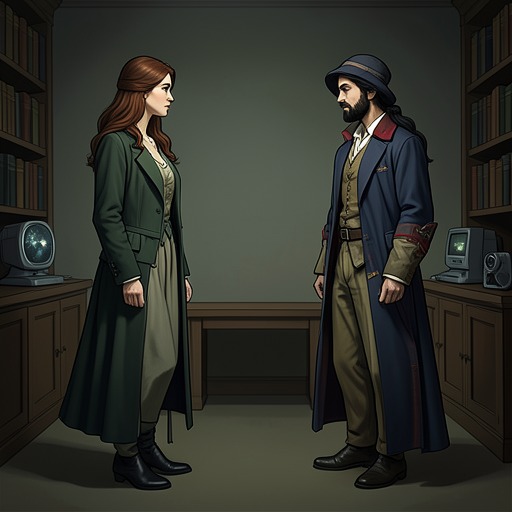
The opposition between Burrus and Caseous
Finnegans WakeThe Burrus–Caseous opposition is a butter-and-cheese polarity that the passage expands into a model of rival qualities, social systems, and desire. Burrus is praised as the natural, mild, supposedly unadulterated choice; Caseous is cast as his contrary, a compromised and more casually sensual figure. Yet their difference cannot remain a clean binary: the narrator describes them as mutually polarized, sets their rivalry within a cash economy, and then introduces Margareen, whose desires complicate the contest. The opposition’s significance lies as much in its unstable, comic presentation as in the contrast it proposes.
The Proposed Polarity
The narrator first frames the conflict through money and possession. A person cannot, under the cash system, have and not have the same coin at once; the image makes mutually exclusive states seem like the rule of both commerce and thought. The passage turns that abstraction into the opposed substances of butter and cheese, which are presented as incompatible products of a shared social stomach. Its deliberately tangled phrasing makes the argument itself feel caught between alternatives rather than securely outside them.
Burrus is introduced as a genuine prime choice: naturally graceful, mild, and described as unbeaten in his own contest. The narrator further labels him obsoletely unadulterous, attaching moral purity to the butter-like ideal. Caseous is “obversely” Burrus’s revision, not an ideal choice by any means, yet also called the better man of the two and portrayed as meltingly addicted to the more casual side of arrival. The reversal matters: the supposedly inferior countertype receives a qualified advantage, so the hierarchy is already less stable than the opposition’s crisp terms imply.
Rival Types and Their Descriptions
The contrast takes on a physical and comic form when the narrator presents Caseous as a poor tyro, marked by holes, high stink, and worm-picking. These deliberately grotesque details turn the dairy metaphor into an insult about the body and social worth. The narrator acknowledges the complaint that the portrait is excessive, then insists the listener is not entirely wrong to object. The voice therefore both performs the caricature and exposes its own participation in making it.
Burrus receives a contrasting portrait organized around wisdom and defensive faith. The narrator imagines him with a rounded head suited to thought, wisdom lodged beneath every dent, and a capacity for clear sight that could still make out the green moat of Ireland’s Eye even from a vast distance. The mock-heroic praise culminates in a youthful image of a king off duty, with a jaw for ever and a cheerful outlook. Biblical and German food allusions then return the ideal to butter and bread: the elevated moral figure is also a comic dairy product, and the praise cannot escape the passage’s appetite and wordplay.
Social and Economic Entanglement
The rivalry is not merely a contest between abstract temperaments. The narrator places both figures within the history of buying and selling, evokes an old party gathered around a communal bowl, and repeatedly draws attention to cash, goods, and exchange. The language of mutually exclusive possession gives the polarity an economic edge, while the two products are described as mutually polarized and incompatible in their actions. They appear to demand separate positions, even as the passage’s images keep bringing them together in the same bowl, social gathering, and system of consumption.
The narrator also refuses to turn the contrast into a final philosophical verdict. Acknowledging that people cannot escape likes and dislikes, exiles and ambushers, beggars and neighbours, the voice asks for tolerance of antipathies rather than unconditional endorsement of either side. It distances itself from competing explanations of how motion, space, and time relate, invoking philosophical positions without settling the dispute. The result is not a stable doctrine of opposites but a comic argument that keeps disclaiming authority even while elaborating its categories.
Margareen and the Complication of the Pair
After describing two male poles, the narrator says that an undistributed middle between them requires a female focus. Margareen then appears at a precisely designated hour, called absolute zero or the babbling pump of platinism. The mock-scientific introduction turns her entrance into a structural pivot: the paired opposition acquires a third figure around whom its rivalry can be staged.
Margareen is said to be very fond of Burrus, but also very fond of cheese. Her preference therefore does not simply confirm the butter-versus-cheese division; it places her affection across it. The narrator adds an elusive Antonius, who is associated with refined cheeses and a boorish manner, producing a triad of Antonius, Burrus, and Caseous. Desire and taste now cross the lines that the earlier economic and philosophical language tried to draw. The narrator’s extravagant account does not resolve the triangle; it makes the opposition more entangled, showing how a pair of rival principles can become a social relation once a third party enters the scene.
A Binary Undone by Its Own Voice
The passage’s language continually makes distinctions and then distorts them. Burrus and Caseous are assigned opposite qualities, but their descriptions carry reversals, qualifications, and shared comic excess. Even the narrator’s supposed instruction about their incompatibility arrives in a voice crowded with self-correction, digression, food puns, and mock learning. Its form enacts the difficulty of holding the two principles apart: each claim of clear polarity opens into another qualification or association.
The opposition thus serves as both subject and method. It gives the passage a framework for thinking about value, taste, commerce, and desire, while its unstable rhetoric refuses to make that framework final. Margareen’s liking for both Burrus and cheese is the clearest plot-level complication, but the deeper complication is linguistic: butter and cheese can be set against one another, praised or disparaged, and made to stand for incompatible positions, yet the narration keeps returning them to shared appetite, shared society, and comic exchange.